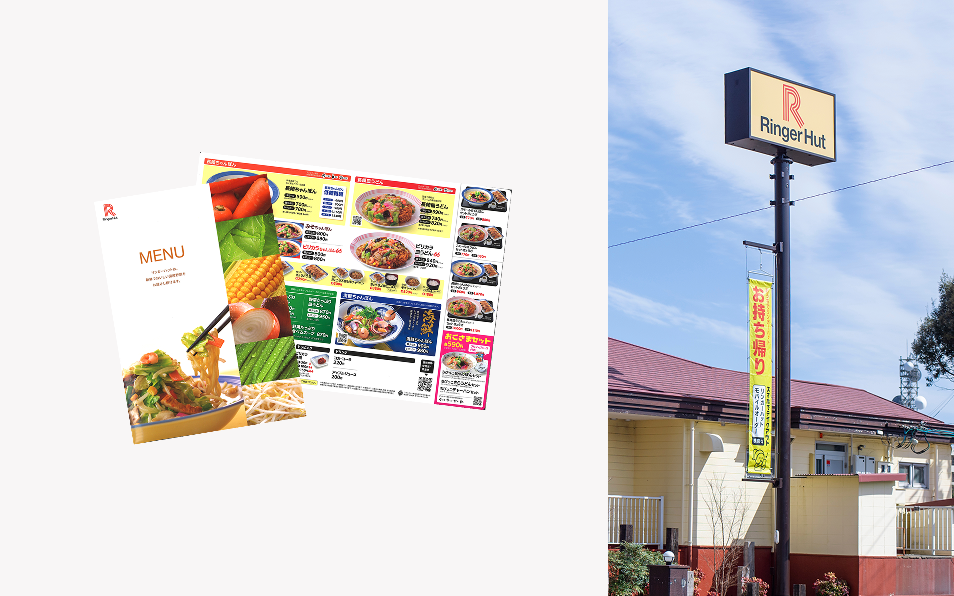
The company was considering concrete measures to reduce its use of plastic and paper. There were durability issues with the conventional laminated menus, such as the corners peeling.
[Adopted Product] Menu
Water usage in the manufacturing process is expected to be reduced by approximately 70 tons1 compared to conventional products. The superior durability of LIMEX prevents premature deterioration, such as the peeling of corners that was an issue with conventional laminated menus2.
*1 This is a calculated value for reference and is not a guaranteed value. *2 Durability tests are still ongoing.
Ringer Hut Co., Ltd. is a company that develops restaurant businesses, including “Nagasaki Champon Ringer Hut.” Aiming to reduce environmental impact and realize a sustainable society, the company promotes various measures such as achieving 100% renewable energy in its three domestic factories, improving its food recycling rate, and reducing the use of single-use plastics through the active use of environmentally friendly containers and packaging.
This time, we spoke with Mr. Abe, who is in charge of sales planning at Ringer Hut, about the background and effects of introducing LIMEX menus.
Mr. Abe's Profile
Team Leader, Sales Planning Team,
Sales Strategy Department Joined Ringer Hut Co., Ltd. in 1993. After serving as a sales manager in the Kyushu, Kansai, Chubu, and Kanto regions, he was in charge of the American business for the overseas promotion team starting in 2021. He assumed his current position in December 2024. He took over the LIMEX introduction project and was involved in its adoption.
A desire to reduce the use of plastic and paper
Please tell us the background for introducing LIMEX.
Mr. Abe: As a company operating in the food sector, which is deeply connected to nature, SDGs are an important theme for us. We have been making various efforts at the store level, such as reducing the use of plastic and paper. Amidst this, a team member learned about LIMEX as an environmentally friendly material, which led us to consider its introduction.
The balance between quality and price is the deciding factor
We heard that you had previously considered stone paper, which is a different material. What was the deciding factor in introducing LIMEX this time?
Mr. Abe: Actually, we did consider stone paper several years ago, but we decided against it at the time due to issues with cost and color transfer during printing. On the other hand, we determined that LIMEX was the most suitable option from the perspective of being environmentally friendly while maintaining price and quality, so we decided to introduce it.
*Difference between LIMEX and Stone Paper: LIMEX is a composite material developed and patented in Japan by TBM Co., Ltd. as an alternative to plastic and paper. Synthetic paper made from limestone, known as stone paper and developed by a Taiwanese manufacturer, differs from LIMEX in its basic patents.
Benefits that are easy to communicate to management and employees
During your internal review, how did you communicate the benefits of LIMEX?
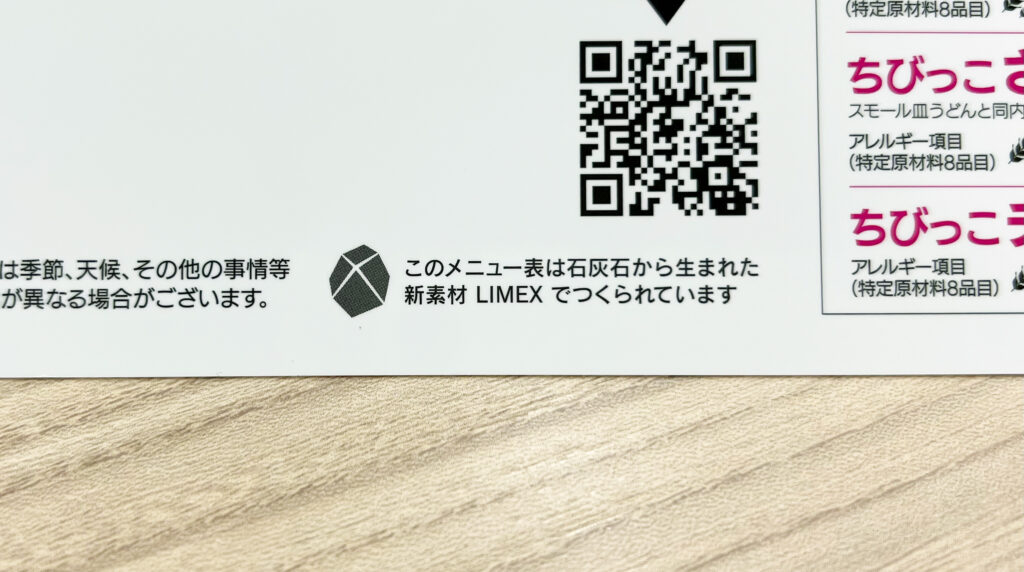
Mr. Abe: In addition to reducing plastic usage, the fact that it contributes to conserving water and forest resources was a clear benefit that was easy to communicate internally. The keywords “do not use paper” and “reduce plastic usage” made the benefits of adoption easy to convey to our SDG-conscious management and employees, which left a good impression. We also value the fact that we can include the LIMEX symbol on the menus used in our stores as a form of appeal, which helps us communicate our initiatives externally.
The menu is the face of the restaurant
Compared to the conventional laminated menus, what differences do you notice?
Mr. Abe: The menu is a communication tool that customers see the most, and it serves as the face of the restaurant. Since customers handle it frequently, durability is extremely important. With our previous menus, we didn’t laminate the paper, and we had problems with the corners peeling away from the adhesive surface. Although we have only just introduced it, we believe that LIMEX, with its appropriate thickness and durability, can solve this problem.
A desire to enhance the corporate image
Through the introduction of LIMEX, how do you plan to expand your initiatives in the future?
Mr. Abe: As a company that uses environmentally friendly materials, it’s easier to communicate this externally, so we expect it to lead to increased awareness both inside and outside the company. Furthermore, by introducing LIMEX, we want to convey our stance of “truly choosing what is environmentally friendly,” not only within the company but also to our employees.
In the long term, we were considering whether we could replace other tools that use plastic and paper, such as coupons distributed at our stores, business cards, and garbage bags, with LIMEX. For many years, our company has valued its commitment to domestic vegetables and safety and security. By adding the introduction of LIMEX to this, we want to promote a more comprehensive approach to sustainability.
As part of their efforts to promote SDGs, Ringer Hut has switched their menus, a key communication tool with customers, to LIMEX. This move embodies the brand’s philosophy and strengthens awareness both internally and externally. TBM will continue to support Ringer Hut’s initiatives to promote social sustainability in the food and beverage industry.
CONTACT
If you have any questions about LIMEX, please feel free to contact us.