Interview
The fact that we haven’t received a big reaction from customers is proof that our efforts are being naturally accepted.
As a pioneer, driving sustainability in the food industry.

*1 As of October 2023. According to TBM research.
*2 Based on TBM’s LCA (Life Cycle Assessment) calculating environmental impact from raw material procurement to disposal. Values may vary depending on manufacturing conditions. These are reference values and not guaranteed values.
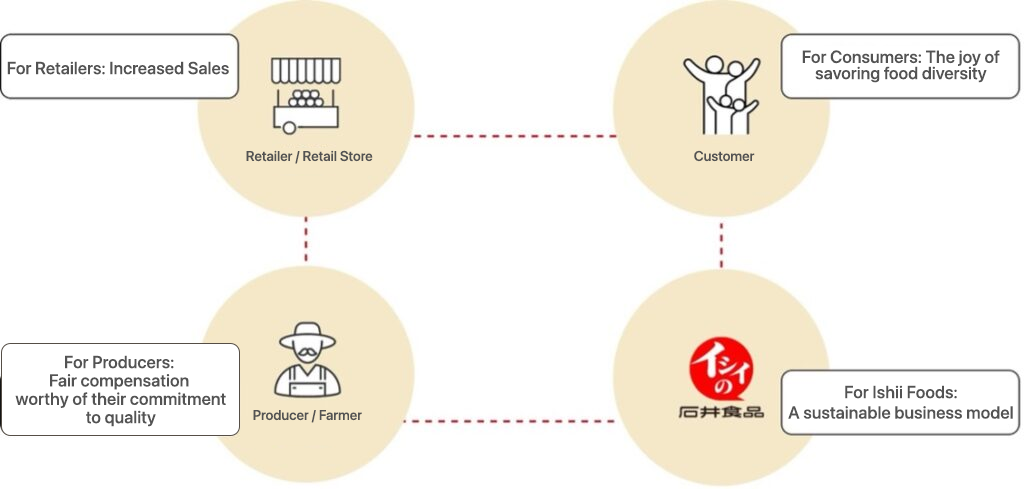
Ishii Foods Co., Ltd. is a food manufacturer that produces additive-free products, including “Chicken Hamburg Steak” and “Meatballs,” without using food additives in the manufacturing process. Furthermore, aiming to realize a sustainable “Local and Seasonal” model, the company is committed to developing food culture through environmentally conscious sourcing of raw materials and co-creation with local communities.
This time, we spoke with Mr. Nakayama, Manager of the Procurement Planning Group within the Material Value Development Department at Ishii Foods, about the background behind introducing LIMEX products and their effects.
【Profile of Mr. Nakayama】
Manager, Procurement Planning Group, Material Value Development Department
Joined Ishii Foods Co., Ltd. in 2010. Currently serves in the Material Value Development Department. Since 2022, has been involved in the LIMEX utilization project in collaboration with TBM Co., Ltd., leading the adoption of LIMEX-based sealant film and its implementation in three products.
Mr. Nakayama: Our company has adopted a new vision for 2030: “To become a company that connects agriculture to the dining table and supports child-rearing.” Ishii Foods’ mission is to create a sustainable “regional and seasonal” model. We are grateful that the Earth’s resources are precious assets and value passing them on to future generations. Therefore, we actively engage not only in sourcing raw materials but also in activities to protect children’s futures and the Earth’s resources, collaborating with local communities.
Our department considers communicating these efforts a crucial role. Specifically, conveying our initiatives for the environment and building a sustainable society in an easy-to-understand way to the children we cherish is also part of our mission.
Business Model “Region and Season” (
https://www.ishiifood.co.jp/csr/region-season/
)
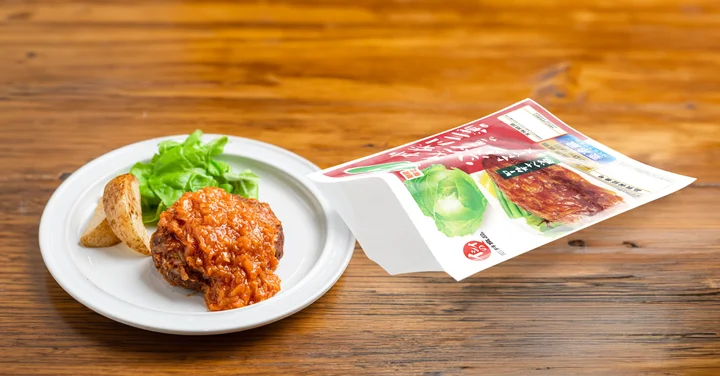
Mr. Nakayama: Our efforts began with the basic agreement signed in 2019 to develop new applications. The adoption of LIMEX started with our management policy document and business cards, followed by its use in osechi trays in 2020. In 2023, we adopted sealant film for the hamburgers in our “Region and Season” series.
Mr. Nakayama: During the initial discussions, points such as “Is this truly an environmentally conscious material?” and “How does it combine with limestone-derived materials or interact with food?” were raised. However, by providing us with various numerical data, including LCA (Life Cycle Assessment)*, we were able to understand specifically how it contributes to the environment. Visualizing the reduction in environmental impact is excellent, as it not only benefits us as the adopters of the material but also provides reassurance to consumers who handle the products. Furthermore, it has successfully cleared hygiene certifications, and we are using it without any issues in combination with food.
Mr. Nakayama: That’s right. As a premise, I feel it’s extremely difficult to effectively communicate our initiatives. Even if we explain verbally that “we use environmentally friendly materials,” it’s hard to truly convey that they are genuinely good for the environment. Therefore, I believe that making environmental considerations visible through numbers has become a crucial element supporting our value of “safety and security.”
*Life Cycle Assessment (LCA): A method for scientifically and quantitatively evaluating the environmental impacts of a product or service throughout its entire life cycle or at specific stages thereof.
Mr. Nakayama: The biggest deciding factor was the opportunity to “become a pioneer.” We are particularly committed to promoting environmentally friendly products, so we believe it’s crucial to lead the way as pioneers.
Regarding film usage, establishing a track record in the food industry opens the door to expansion into other sectors. This is another key reason we are driving this initiative forward. At the same time, we don’t view our role as monopolizing this technology as pioneers within the food industry. Instead, we prioritize the perspective of “how can we ensure this technology spreads throughout the entire food industry?” Founded in 1945, immediately after the war, our company culture is deeply rooted in the spirit of “building a better society.” We are very conscious of this and actively work towards it.
Mr. Nakayama: As another environmentally conscious material, we also utilize biomass at our company and consider it an excellent option. However, there were constraints such as supply, cost, and rights issues. Within this context, we value LIMEX for its high cutability, which leverages the material’s properties, and its significant environmental impact reduction compared to conventional biomass.
Furthermore, as mentioned earlier, we also have a desire to pioneer the spread of LIMEX in the world. Our shared commitment to actively promoting environmentally beneficial products aligns with yours, and we look forward to collaborating on this endeavor.
Mr. Nakayama: Your company’s development team members strike me as highly professional. This time, too, beyond discussing the development of this product, you provided me with a broad range of industry insights, which served as an opportunity for me personally to deepen my understanding of the industry.
Mr. Nakayama: To be honest, I was worried we might receive complaints. However, since introducing it, we haven’t received any such feedback, and it’s being used without any issues.
Take our meatballs, for example. As products that have been loved for years, it’s crucial that items customers pick up without a second thought can, over time, contribute to protecting the environment and building a future for children.
While we’re naturally delighted when customers appreciate our efforts, we also believe it’s vital to contribute to building a better planet by consistently implementing these fundamental initiatives. In that sense, the lack of major reactions itself is proof that our efforts are being naturally accepted.
Mr. Nakayama: First, we are working on modifying the film to fit our current production lines. Once this is achieved, it will be usable across all our factories, paving the way for mass production. Beyond that, we can envision its adoption in our long-selling meatballs. Also, since conditions vary by machine, we want to develop a universally applicable product together. Achieving this would increase the likelihood of adoption by other companies, and ultimately, we believe it can be expanded to the entire industry.
Under the vision of “Connecting agriculture to the dining table and supporting child-rearing,” Ishii Foods is advancing initiatives toward realizing a sustainable society. TBM will continue to support Ishii Foods’ efforts to promote societal sustainability within the food industry.